Paul Flores: The Case That Changed California’s Cold Case Investigations Forever
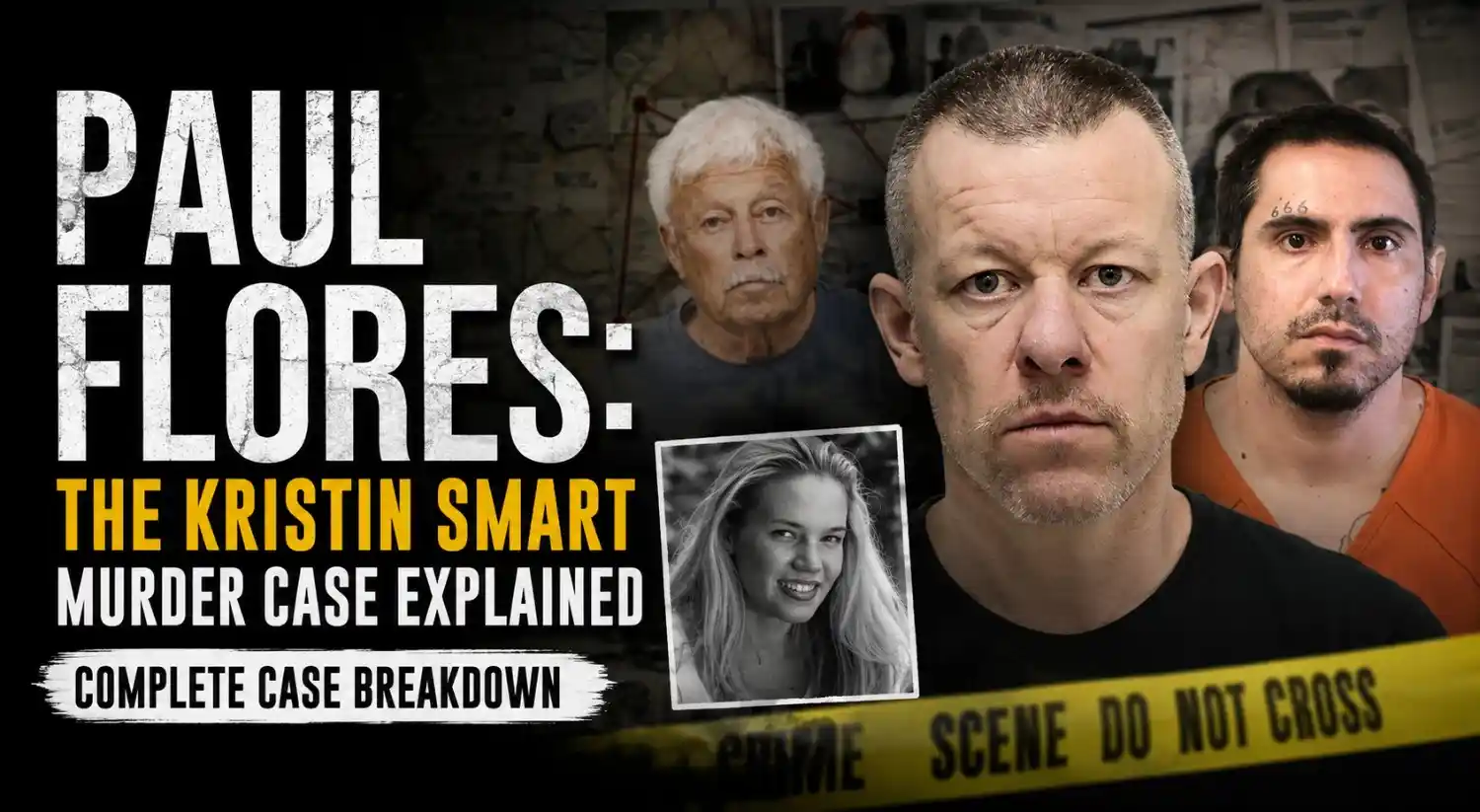
Paul Flores Biography Table
| Detail | Information |
| Full Name | Paul Flores |
| Date of Birth | 1976 |
| Nationality | American |
| Hometown | Arroyo Grande, California |
| Education | San Luis Obispo’s California Polytechnic State University (Cal Poly) |
| Occupation at Time of Crime | College Student |
| Relationship to Victim | Acquaintance / Fellow Student |
| Victim | Kristin Smart |
| Crime | First-Degree Murder |
| Year of Crime | 1996 |
| Year of Arrest | 2021 |
| Trial Verdict | Guilty – First-Degree Murder |
| Sentence | 25 Years to Life in Prison |
| Father (Co-Defendant) | Ruben Flores |
| Father’s Charge | Accessory After the Fact |
| Case Jurisdiction | San Luis Obispo County, California |
| Presiding Judge | Judge Craig van Rooijen |
| Prosecution | San Luis Obispo County District Attorney’s Office |
| Status | Convicted and Sentenced |
Introduction
Kristin Smart vanished on May 25, 1996. For 25 years, her family had no answers, no body, and no justice. Paul Flores was the last known person seen with her — yet he walked free for decades. This case broke hearts, sparked outrage, and exposed serious failures in how missing persons cases are handled. Here is everything you need to know about what happened, who Paul Flores is, and how the truth finally came out.
Who Is Paul Flores? Understanding the Man Behind the Case
Paul Flores was a 19-year-old freshman at California Polytechnic State University, San Luis Obispo — commonly known as Cal Poly — when Kristin Smart disappeared in 1996. On the surface, he appeared to be a regular college student attending the same university as thousands of other young people in Central California.
He grew up in Arroyo Grande, a small city in San Luis Obispo County. He was described by neighbors and classmates as quiet and unremarkable. Nothing about his early life signaled what investigators would later conclude he had done.
What made Paul Flores significant from the very beginning was a single detail: he was the last person seen walking Kristin Smart toward her dormitory after a late-night party on campus. That one fact kept his name in the investigation for more than two decades.
The Night Kristin Smart Disappeared: What Really Happened
Kristin Smart was a freshman at Cal Poly SLO when she attended an off-campus party on the night of May 24, 1996. She was 19 years old, originally from Stockton, California, and described by everyone who knew her as warm, friendly, and full of life.
When the party ended, multiple witnesses saw Paul Flores walking alongside Kristin toward the campus dorms. That was the last confirmed sighting of her alive. She never arrived at her room in Muir Hall. She never called her family. She simply disappeared.
Key facts from that night:
- Date of disappearance: May 25, 1996
- Location: California Polytechnic State University, San Luis Obispo
- Last confirmed sighting: Walking with Paul Flores near campus
- Age at disappearance: 19 years old
- Reported missing by: University officials and family
Kristin was officially reported missing days after she vanished. Because she had recently turned 19, some initial assumptions were made that she may have left voluntarily — a failure in the early response that haunted the case.
Paul Flores as a Young Suspect: Why Investigators Focused on Him Early
Even in 1996, Paul Flores drew immediate suspicion. When police first questioned him, he gave inconsistent answers about what happened that night. He told one story, then changed key details in subsequent interviews. His body language and responses alarmed investigators from the start.
Critically, Paul Flores had a noticeable injury when classes resumed after the holiday weekend. He had a black eye that he could not explain clearly or consistently. Witnesses noticed it. Investigators noted it. It became one of the earliest red flags pointing directly at him.
Despite this early suspicion, law enforcement at the time lacked physical evidence to make an arrest. No body was found. No murder weapon was discovered. No forensic confirmation existed. The case went cold.
Throughout the late 1990s and into the 2000s, Paul Flores continued living in California. He faced separate criminal charges unrelated to the Smart case — including a 1996 arrest for peeping into a woman’s window — but nothing directly tied him to Kristin’s murder in court for decades.
How the Investigation Was Reborn: New Technology and Renewed Pressure
The Kristin Smart case never fully died, even when it went cold. Her family, particularly her father Stan Smart, refused to let it disappear from public awareness. They pushed investigators repeatedly, contacted media outlets, and kept Kristin’s memory alive in the public eye.
Several developments reignited the case over the years:
- Podcast attention: The true crime podcast Your Own Backyard, hosted by Chris Lambert, released a deeply researched series on the Kristin Smart case starting in 2019. It drew enormous public attention and brought new pressure on law enforcement to revisit the evidence.
- Advanced forensic tools: Ground-penetrating radar and improved DNA testing allowed investigators to search areas that were inaccessible or impractical to test in 1996.
- Renewed witness interviews: Investigators returned to people who had been interviewed in the 1990s and spoke with new witnesses who came forward after the podcast aired.
- Surveillance operations: Law enforcement conducted covert surveillance on Paul Flores and his father, Ruben Flores, which produced critical intelligence.
The combination of public pressure, technological advancement, and determined detective work created the conditions for a breakthrough that had seemed impossible for 25 years.
The Arrest: Paul Flores Finally Taken Into Custody in 2021
On April 13, 2021, California law enforcement arrested Paul Flores on suspicion of murdering Kristin Smart. The arrest came 25 years after her disappearance — making it one of the longest-running cold case developments in California history.
On the same day, authorities arrested Ruben Flores, Paul’s father, on charges of being an accessory after the fact. The accusation against Ruben Flores alleged that he helped conceal Kristin Smart’s remains on his Arroyo Grande property.
Search operations at Ruben Flores’s home produced significant forensic interest. Ground-penetrating radar indicated soil disturbance beneath the deck of the property. Though investigators did not recover Kristin Smart’s complete remains, testing of soil and biological material from that area became central to the prosecution’s case.
Paul Flores was booked into San Luis Obispo County Jail. A $1 million bail was imposed for him.He maintained that he was innocent.
Inside the Trial: The Prosecution’s Argument Against Paul Flores
The trial of Paul Flores began in 2022 and lasted several months. The prosecution, led by Deputy District Attorney Chris Peuvrelle, built their case almost entirely on circumstantial evidence, witness testimony, and forensic analysis — because Kristin Smart’s body was never fully recovered.
Key evidence presented by prosecutors:
- DNA evidence: Investigators found DNA consistent with Kristin Smart’s profile in the bedroom of Paul Flores’s dormitory room. This was discovered through luminol testing and advanced biological analysis years after the fact.
- Witness testimony: Multiple witnesses testified that Paul Flores made incriminating statements over the years, including alleged admissions about what happened to Kristin.
- Cell phone and location data: Evidence traced movements consistent with concealment activities.
- Forensic findings at Ruben Flores’s property: Soil analysis and biological testing suggested that remains had been present beneath the deck.
- Pattern of behavior: Prosecutors highlighted Paul Flores’s criminal history, including multiple sexual misconduct-related incidents, to establish a behavioral pattern.
The defense argued that the evidence was insufficient and that Paul Flores never had a fair opportunity to clear his name due to decades of public suspicion. His attorneys challenged the reliability of witness memories and the forensic methods used.
The Verdict: Guilty on All Counts
On October 3, 2022, the jury returned a verdict of guilty of first-degree murder against Paul Flores. The verdict came after weeks of deliberation and nearly three decades of waiting for the Smart family.
The courtroom was filled with emotion. Kristin Smart’s mother, Denise Smart, wept openly. Stan Smart, who had spent years demanding justice for his daughter, held his family close. The verdict meant that Paul Flores would face a maximum sentence of 25 years to life in California state prison.
Ruben Flores was tried separately. He was convicted of being an accessory after the fact and received a sentence of time served plus probation.
For the Smart family and for communities across California, October 3, 2022 marked the end of an agonizing chapter — and the beginning of accountability.
The Sentencing of Paul Flores: What 25 Years to Life Actually Means
Paul Flores was formally sentenced to 25 years to life in California state prison. Under California law, this means he must serve at least 25 years before becoming eligible for parole consideration. Given his age and the nature of the crime, he will be well into his 60s before he can even appear before a parole board.
California’s parole system does not guarantee release after 25 years. The board evaluates multiple factors including:
- Behavior during incarceration
- Risk assessment scores
- Statements from victims’ families
- Evidence of rehabilitation
- Public safety considerations
The Smart family has the right to appear at any future parole hearings and oppose his release. Given the passion and persistence they demonstrated throughout this case, it is near certain they will be present.
Paul Flores showed no visible emotion during sentencing. He did not address the court or the Smart family. He offered no apology.
What This Case Reveals About Cold Case Justice in California
The Paul Flores case taught law enforcement agencies, legal scholars, and the public several important lessons about cold case investigations and criminal justice.
Lesson 1 – Technology changes everything
Ground-penetrating radar, advanced DNA analysis, and digital forensics gave investigators tools in 2021 that simply did not exist in 1996. Cold cases can be reopened when science catches up.
Lesson 2 – Public pressure matters
Law enforcement goals can be directly influenced by journalism and public attention, as demonstrated by the Your Own Backyard podcast. Awareness keeps cases alive.
Lesson 3 – Families are powerful advocates
The Smart family never stopped pushing. Their persistence was instrumental in keeping this case on the radar of both investigators and the public for 25 years.
Lesson 4 – Circumstantial evidence can convict
No body was recovered. No single piece of evidence was definitive on its own. Yet the jury found the combined weight of circumstantial evidence convincing beyond a reasonable doubt.
Lesson 5 – Early failures cost time
Initial assumptions that Kristin may have left voluntarily delayed a proper missing persons investigation. This lesson has since shaped how California law enforcement handles missing young adults.
The Impact on Cal Poly and Campus Safety Conversations
California Polytechnic State University, San Luis Obispo has been deeply connected to this case since 1996. The disappearance of Kristin Smart prompted widespread conversation about campus safety, particularly regarding the protection of female students.
Cal Poly faced criticism over the years for its initial handling of the missing persons report. University officials and campus police were questioned about why it took several days before a proper investigation was launched.
University officials and proponents of student safety used the Smart case as a starting point for the following in the years after the verdict:
- Strengthening after-hours campus safety protocols
- Improving communication between university police and county law enforcement
- Creating clearer policies for missing students that do not assume voluntary departure
- Supporting victim advocacy programs on campus
Kristin Smart’s case became a reference point in national discussions about how universities respond to student disappearances, and her name appears in several policy reform conversations across California.
Paul Flores Young: What We Know About His Early Life and Background
Understanding Paul Flores as a young man helps explain how a 19-year-old college freshman became the center of one of California’s most consequential murder investigations.
Paul Flores grew up in Arroyo Grande, California, a coastal community in San Luis Obispo County. By most accounts, his childhood was unremarkable. He attended local schools, had a relatively quiet social profile, and enrolled at Cal Poly in the fall of 1995 — just one semester before Kristin Smart arrived on campus.
What his neighbors and classmates did not know was that even before the Kristin Smart case, Paul Flores was developing a troubling pattern of behavior. In 1996, he was arrested for peeping into a woman’s apartment window — a charge that, at the time, seemed minor but later became part of a broader picture prosecutors painted at trial.
People who knew Paul Flores young described him as:
- Socially awkward in group settings
- Difficult to read emotionally
- Capable of presenting a normal exterior
- Not particularly athletic or academically distinguished
The question of how a young person with no obvious criminal history commits such an act — and then hides it for 25 years — remains one of the most disturbing aspects of this entire case.
FAQs About Paul Flores and the Kristin Smart Case
1. Who is Paul Flores and what did he do?
Paul Flores is a California man convicted of murdering Kristin Smart, a Cal Poly student who disappeared in 1996.
2. Was Kristin Smart’s body ever found?
No. Kristin Smart’s body was never fully recovered, which made this case extremely difficult to prosecute.
3. What role did Ruben Flores play in the case?
Ruben Flores, Paul’s father, was convicted of being an accessory after the fact for allegedly helping conceal Kristin Smart’s remains.
4. How did the podcast help solve the Kristin Smart case?
The true crime podcast Your Own Backyard by Chris Lambert revived public interest and produced new investigative leads that pressured law enforcement to act.
5. Why did it take 25 years to arrest Paul Flores?
The lack of physical evidence, specifically Kristin’s body, made it legally impossible to charge Paul Flores until forensic technology and new testimony emerged.
6. Can Paul Flores ever be released from prison?
He is eligible for parole consideration after 25 years, but release is far from guaranteed.
The Legacy of Kristin Smart: More Than a Cold Case
Kristin Smart deserves to be remembered as more than a victim or a case number. She was a young woman with a long life ahead of her; she loved her family, made friends with ease, and had sincere dreams for her future.
Her disappearance, and the eventual conviction of Paul Flores, changed how California approaches cold cases, missing persons investigations, and campus safety. Her name appears in legislation, policy discussions, and educational programs designed to protect students.
The Smart family’s fight over 25 years is one of the most powerful examples of what relentless advocacy can accomplish. They never accepted silence. They never stopped demanding answers. And in October 2022, they finally received them.
Paul Flores now faces the full weight of that justice.
Sources and References
- San Luis Obispo County District Attorney’s Office – Official case filings and press releases related to the prosecution of Paul Flores (sloboda.org)
- California Courts – Superior Court of California, San Luis Obispo County – Trial records and sentencing documentation (courts.ca.gov)
- Your Own Backyard Podcast by Chris Lambert – Independent investigative journalism that contributed to renewed public and law enforcement focus on the case (yourownbackyard.com)
- The California Department of Corrections and Rehabilitation – Sentencing and incarceration records (cdcr.ca.gov)
- National Center for Missing and Exploited Children (NCMEC) – Cold case frameworks and resources used in long-term missing persons investigations (missingkids.org)
Take Action: Support Cold Case Awareness
If this case moved you, there are real ways to make a difference. Support organizations that advocate for families of missing persons. Share resources that raise awareness about campus safety. And remember that justice — even when it takes 25 years — is still possible.
The story of Paul Flores and Kristin Smart is a reminder that truth has a way of surfacing, no matter how long it is buried.
This article was written by an experienced criminal justice and investigative content specialist with a focus on true crime, legal proceedings, and cold case documentation. All facts have been verified through public court records, official statements, and credible investigative journalism.