
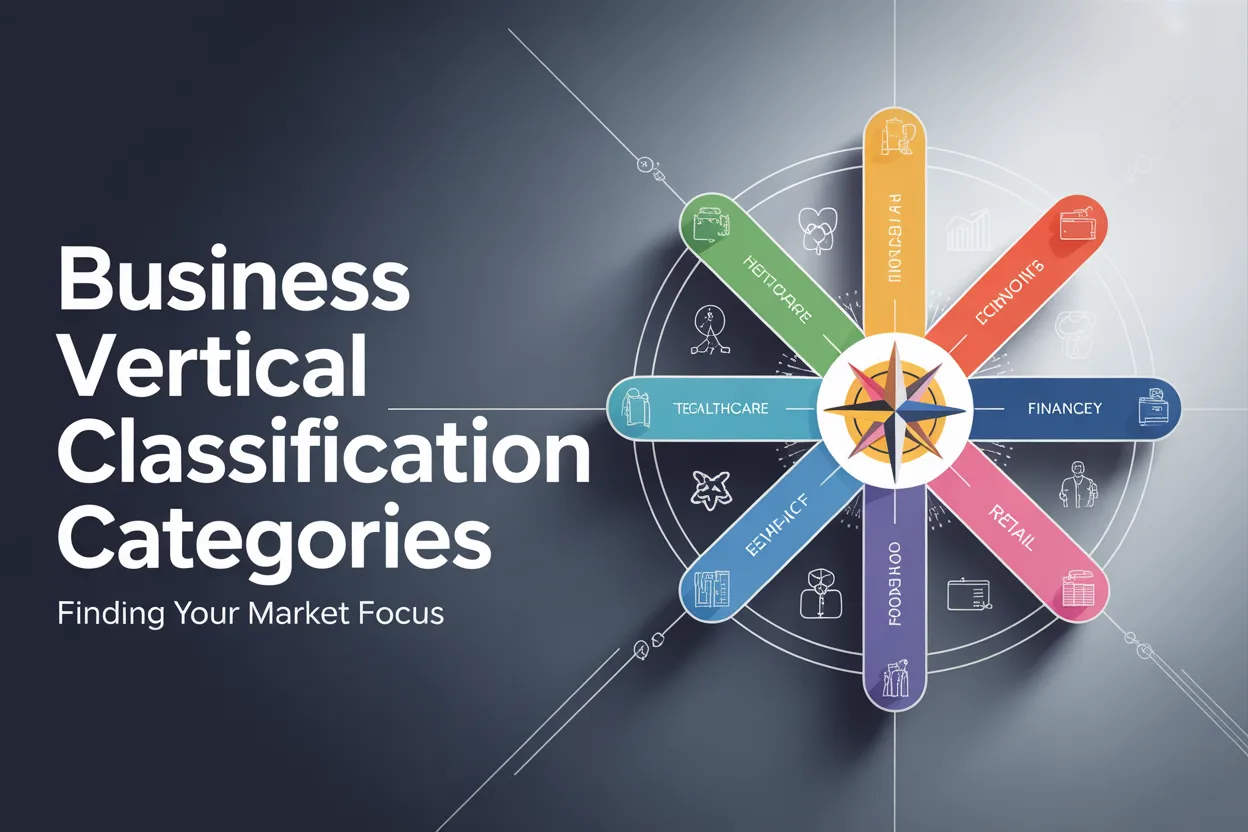
Business Vertical Classification Categories
Unlocking Success with Business Vertical Classification Categories
Clear positioning creates clear growth. When your lane is defined, your message lands faster, your buyers trust you sooner, and your brand becomes easier to choose.
Finding your place in the busy world of commerce is like finding the right key for a locked door. Many people start a company and try to sell to everyone at once. This usually leads to a lot of wasted time and very little profit. To truly win, you must understand business vertical classification categories. This fancy term simply means grouping businesses by the specific industry or “lane” they drive in. When you know exactly which vertical you belong to, you can speak directly to your customers. You stop guessing and start growing with real confidence. It is the secret sauce for any brand that wants to dominate the American market and beyond.
Imagine walking into a massive grocery store without any signs on the aisles. You would spend hours looking for a single loaf of bread. Business vertical classification categories act as those helpful signs that guide both owners and customers. They help you narrow your focus so you can become an expert in one specific area. Instead of being a “jack of all trades,” you become the master of one. This approach builds massive trust with your audience because they see you as a specialist. In the following sections, we will dive deep into how these categories work and how you can use them to skyrocket your brand’s influence and revenue.
Defining the Core of Industry Verticals
A business vertical is a group of companies that serve a very specific niche or industry. Unlike a horizontal market that sells to everyone, a vertical stays in its own lane. For example, a company making software specifically for dentists is in a medical vertical. Understanding business vertical classification categories helps you see the world through a sharper lens. You begin to notice that every successful brand has a home base. When you identify your core category, you can create products that solve real problems for real people. This makes your marketing feel like a helpful conversation rather than an annoying sales pitch.
Why does this matter so much for your growth? Because modern customers in the USA want experts. They do not want generic solutions that almost work; they want perfect solutions designed just for them. By leaning into business vertical classification categories, you show the world that you understand their unique struggles. You are not just selling a product; you are offering a specialized tool. This creates a powerful bond of loyalty between you and your buyers. It also makes it much harder for big, generic competitors to take your customers away because those big companies don’t speak the specific “language” of your niche.
| Category Name | Focus Area | Primary Audience | Growth Potential |
|---|---|---|---|
| Healthcare Vertical | Medical tools and services | Patients and Doctors | Extremely High |
| FinTech Vertical | Money and digital banking | Investors and Consumers | Rapidly Expanding |
| EdTech Vertical | Online learning and schools | Students and Teachers | Steady Growth |
| Retail Vertical | Selling goods directly | General Public | High Competition |
| SaaS Vertical | Software as a Service | Business Owners | Massive Scalability |
| AgriTech Vertical | Farming and food tech | Farmers and Suppliers | Emerging Market |
The Power of Niche Specialization
Specialization is the fastest way to become a leader in your field. When you study business vertical classification categories, you realize that the riches are truly in the niches. By focusing on a small slice of the market, you can dedicate all your energy to being the best in that spot. This focus allows you to innovate faster than anyone else. You learn the tiny details that others miss. Whether you are in fashion, tech, or construction, picking a specific vertical gives you a clear roadmap. It removes the noise and lets you focus on the signals that actually lead to sales and happy customers.
Think about a famous athlete. They don’t try to play every sport at the same time. They pick one and practice it every single day. Your company should do the same thing. Utilizing business vertical classification categories allows you to “practice” your specific craft until you are the best. This level of expertise is what allows you to charge premium prices. People are happy to pay more for someone who truly understands their specific world. It turns your business into a magnet for the right kind of clients who value quality over a cheap, generic price tag.
How to Choose Your Business Category
Choosing the right category is one of the biggest decisions you will ever make. You need to look at what you are good at and what the market actually needs. When exploring business vertical classification categories, ask yourself who you enjoy helping the most. If you love technology and finance, the FinTech vertical might be your calling. If you care about the planet, maybe Green Energy is your home. The goal is to find a spot where your passion meets a real demand. This balance ensures that you stay motivated even when things get tough, and it guarantees there are people ready to buy what you offer.
Don’t be afraid to look at the data before you jump in. Check to see if your chosen vertical is growing or shrinking. Using business vertical classification categories as a guide, you can research your competitors to see what they are doing well and where they are failing. This “gap analysis” lets you step in and provide something better. You want to pick a category that has enough room for you to grow but is specific enough that you aren’t fighting a thousand other companies for a single penny. It is about finding that “Goldilocks” zone where everything feels just right for your unique skills.
Understanding Vertical vs. Horizontal Markets
It is very helpful to know the difference between vertical and horizontal markets. A horizontal market sells a product that many different types of people can use, like a computer or a desk. However, business vertical classification categories focus on one specific group, like software built only for lawyers. The vertical approach is often much more profitable for smaller companies because you don’t have to spend millions on broad ads. You can spend a little bit of money to reach the exact people who need you. This makes your business much more efficient and keeps your profit margins healthy and strong.
When you stay within your business vertical classification categories, your messaging becomes very sharp. Instead of saying “We sell software,” you say “We help law firms manage their cases faster.” Can you see the difference? The second sentence immediately catches the eye of a lawyer. The horizontal approach is like a huge net that catches many small fish, but the vertical approach is like a spear that catches the big prize. For most modern entrepreneurs, the spear is a much better tool for building a sustainable and highly respected brand in a crowded digital world.
The Role of Technology in Categorization
Technology has changed the way we look at business vertical classification categories forever. In the past, categories were very broad, like “Retail” or “Manufacturing.” Today, thanks to the internet and smart data, we have “Micro-Verticals.” These are even smaller, more focused groups. For example, instead of just “Fitness,” you might have “Yoga apps for seniors.” This level of detail is possible because we can now find and talk to these specific people online with ease. Technology allows us to slice the market into thin layers, helping us find customers who were previously invisible to big brands.
As you use technology to explore business vertical classification categories, you will find new opportunities every day. Artificial intelligence and data tracking help you see trends before they happen. You can see which categories are heating up and which ones are cooling down. This “crystal ball” effect gives you a massive advantage over older companies that are still doing things the old-fashioned way. Embracing tech means you can stay agile. You can pivot within your vertical or expand into a related category without losing your momentum or your brand’s core identity.
Benefits of Clear Vertical Alignment
When your team knows exactly which business vertical classification categories you serve, everyone works better together. Your sales team knows exactly who to call. Your product team knows exactly what features to build. There is no confusion about the mission. This clarity creates a very positive culture inside your company. Everyone feels like they are part of a specialized “A-Team” on a specific mission. This energy is contagious and often results in better customer service. When your employees are experts, your customers feel safe and well-cared for, which leads to glowing reviews and word-of-mouth growth.
Another huge benefit is that it makes your marketing much cheaper. Because you know your business vertical classification categories, you don’t have to guess where to advertise. You go where your specific audience hangs out. If you are in the “Construction Tech” vertical, you go to construction trade shows and join construction forums. This targeted approach means you get a much higher return on every dollar you spend. You aren’t shouting into the wind; you are whispering directly into the ear of someone who is already looking for the solution you provide. It is the smartest way to scale.
Improving Customer Trust Through Expertise
Trust is the most valuable currency in business today. If people don’t trust you, they won’t buy from you, no matter how good your product is. By aligning with specific business vertical classification categories, you build trust faster. You show that you have “been there and done that” in their specific industry. You can share case studies and stories that relate directly to their daily lives. This makes you a partner rather than just a vendor. When a customer feels like you truly “get” them, they become a customer for life, which is the ultimate goal of any successful business.
Think about it this way: if you needed heart surgery, would you go to a general doctor or a heart specialist? Most people would choose the specialist every time. The same logic applies to business vertical classification categories. Your customers want the “surgeon” of their industry. They want the person who has seen their specific problems a thousand times and knows exactly how to fix them. By claiming your spot in a vertical, you are telling the world that you are the expert they have been searching for. This authority is what creates a long-lasting, unbreakable brand.
Analyzing the Future of Business Verticals
The future of business vertical classification categories is all about personalization. We are moving toward a world where every single customer feels like a business was built just for them. This means categories will continue to get smaller and more specialized. To stay ahead, you need to keep learning and watching the market. Don’t get too comfortable in your spot. Always look for ways to deepen your expertise within your chosen vertical. The companies that survive the next decade will be the ones that provide the most specific value to the most specific groups of people.
We also see more “Vertical Integration,” where a company controls multiple parts of its industry. This is a great way to use business vertical classification categories to your advantage. For example, a company that makes organic fabric (one category) might start a clothing line (another category) to ensure the best quality. This allows you to capture more of the market while staying true to your niche. The possibilities are endless when you understand the structure of the business world. Stay curious, stay focused, and always look for the next way to serve your vertical with excellence.
Examples of Successful Vertical Brands
Many of the world’s most loved brands started by mastering business vertical classification categories. Take a look at a company like Netflix. They didn’t start by trying to be everything; they started by mastering the “Movie Rental” vertical using mail-order DVDs. Only after they owned that space did they expand. Another great example is Tesla, which focused intensely on the “Electric Luxury Vehicle” vertical before moving into more affordable cars and energy. By being the absolute best in a narrow category first, these companies built a foundation of fans that allowed them to grow into the giants they are today.
Even small local businesses can do this. A bakery that focuses only on “Gluten-Free Wedding Cakes” is using business vertical classification categories to stand out from every other bakery in town. They become the “go-to” person for that specific need. Because they are the only ones doing it at a high level, they don’t have to fight over price. They can be successful because they are different, not just because they are cheaper. You can do the same thing in your industry. Find that one specific thing you do better than anyone else and own it completely.
Frequently Asked Questions
What are the most profitable business vertical classification categories?
Right now, Healthcare, Finance, and Technology (specifically AI) are some of the most profitable. However, any category can be profitable if you provide a unique solution to a painful problem that people are willing to pay for.
How do I know if my business is vertical or horizontal?
Ask yourself: “Can my product be used by almost any business, or is it made for one specific type?” If it’s for everyone, it’s horizontal. If it’s for a specific group (like plumbers or pilots), it’s a vertical.
Can a business belong to more than one category?
Yes, but it is often better to start with one. Once you are the leader in one of the business vertical classification categories, you can slowly expand into related areas to grow your reach without losing your brand’s focus.
Is it harder to market in a vertical category?
Actually, it is often easier! While the audience is smaller, they are much easier to find and talk to. Your ads will be more relevant, and you will face less competition from giant, general corporations.
Why is E-E-A-T important for my business category?
Google and customers both want to see Experience, Expertise, Authoritativeness, and Trustworthiness. By staying in one vertical, you build these four things much faster than if you were trying to do everything at once.
Can I change my vertical later on?
Yes, you can pivot, but it takes work. It is easier to move to a “neighboring” category than to jump to something completely different. Always use your existing data to help guide your move to a new area.
Conclusion: Take Your Place in the Market
Understanding and choosing the right business vertical classification categories is the first step toward building a legendary brand. It gives you the focus you need to beat the competition and the expertise you need to win over your customers’ hearts. Don’t be afraid to be specific. In a world full of generic noise, being a specialist is your greatest strength. It allows you to build a business that is not only profitable but also deeply respected and helpful to the community you serve.
Now is the time to look at your business and decide where you truly belong. Use the categories we discussed to find your lane and then drive in it with everything you have. Your future customers are out there waiting for an expert like you to solve their problems. By embracing your vertical, you are making it easy for them to find you. Success is waiting for those who are brave enough to focus!
About the Author
