Brand Name Normalization Rules: The Complete Guide to Clean, Consistent Brand Data
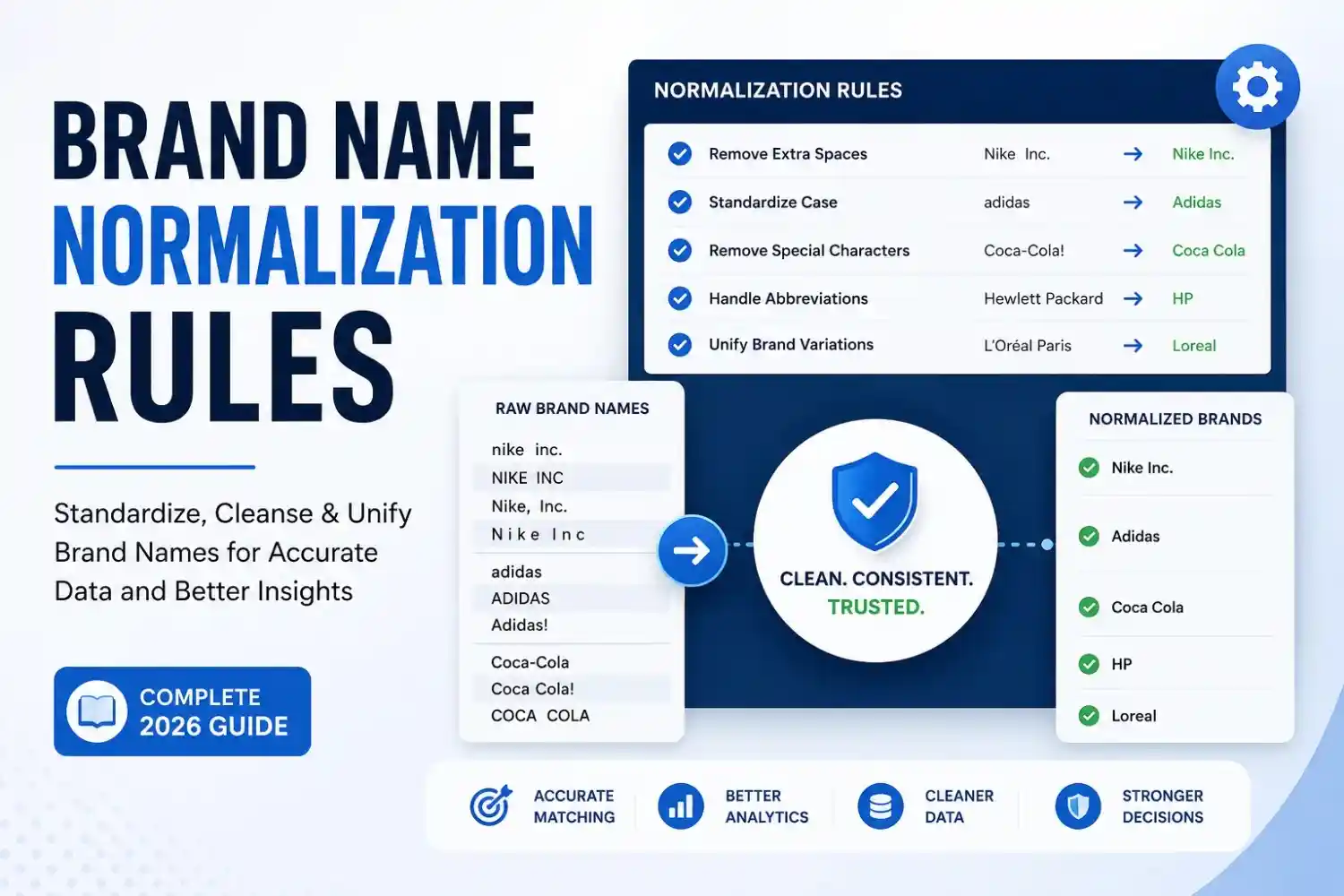
Your dashboard shows Nike three separate times. Once as “Nike,” once as “NIKE,” once as “Nike Inc.” Your revenue looks split. Your reports look broken. Your team wastes hours reconciling numbers that were never actually wrong — just messy. That’s the exact problem that solid brand name normalization rules are built to solve, and this guide walks you through building them from scratch.
What Are Brand Name Normalization Rules?
Brand name normalization rules are the written standards a company uses to record, format, and store brand names the same way, every time, in every system. Instead of letting each department type a brand name however it likes, these rules force one approved version — called the canonical name — and map every other spelling back to it.
Think of it as a dictionary for your data. When ten systems agree on one spelling, reports stop lying to you.
Without brand name normalization rules, the same company can appear as “Coca-Cola,” “Coca Cola,” and “COCA-COLA CO.” across three different tools. To a human, these are obviously the same brand. To a database, they’re three unrelated strings of text.
Why Brand Names Turn Messy in the First Place
Inconsistency rarely happens on purpose. It builds up quietly, from a few common sources.
- Manual data entry — Different employees type the same brand differently, with or without punctuation, capital letters, or suffixes.
- System limitations — Older software may strip special characters, auto-capitalize text, or reject accented letters.
- Marketing drift — A brand’s name can shift slightly across ad campaigns, packaging, and social posts, and those variations quietly leak into internal records.
- Global operations — Translated spellings, removed accents, and regional naming habits create dozens of near-identical entries.
- Mergers and acquisitions — Combining two companies means combining two brand databases, usually without a shared standard.
None of these causes are dramatic on their own. Together, they quietly corrupt reporting accuracy across an entire organization.
Why Brand Name Normalization Rules Actually Matter
Some teams treat this as a cosmetic issue. It isn’t. Clean brand naming touches nearly every function in the business.
Reporting and Analytics Accuracy
When one brand exists in five formats, revenue gets split five ways. A dashboard might show weak performance for a brand that’s actually thriving — the numbers are just scattered across duplicate entries. Forecasting models trained on this fractured data produce weaker predictions, because history itself looks inconsistent.
SEO and Search Visibility
Search engines look for consistent brand signals across your website, product pages, and structured data. When a brand name shifts format from page to page, search engines may fail to connect those pages to a single entity. Applying brand name normalization rules across your site strengthens topical authority and helps search engines recognize your brand as one clear, trustworthy entity.
Customer Trust
A customer who sees one brand name on your homepage and a different one on their invoice notices. Small inconsistencies chip away at trust, even when the underlying company is identical.
Legal and Compliance Exposure
Regulated industries need accurate brand representation in contracts, filings, and financial statements. Loose naming habits create real legal risk, especially in finance and healthcare sectors.
The Core Building Blocks of Effective Brand Name Normalization Rules
| Rule Component | What It Controls | Example |
| Canonical Name | The single official spelling everyone must use | “Nike” (not “NIKE” or “Nike, Inc”) |
| Capitalization Standard | Title case, sentence case, or all caps | “Coca-Cola” not “COCA COLA” |
| Legal Suffix Policy | Whether Inc., LLC, Ltd. appear in general use | “Apple” for marketing, “Apple Inc.” for contracts |
| Abbreviation Policy | Full name vs. acronym, chosen once | “IBM” or “International Business Machines,” not both |
| Punctuation Standard | Handling of &, hyphens, apostrophes | “H&M” not “H and M” |
| Regional Mapping | How local spellings map to the global name | Local spelling → single global canonical name |
A strong set of brand name normalization rules covers every row in that table before it ever touches production data.
Step-by-Step: How to Build Brand Name Normalization Rules
Step 1: Run a Full Data Audit
Pull every brand name variant from every system — sales, marketing, finance, CRM, e-commerce. You’ll likely find the same brand written five or six different ways. This audit quantifies the actual damage and gives you a case for change.
Step 2: Build a Master Brand List
Create one authoritative list of canonical brand names. This becomes your single source of truth. Every future brand entry gets checked against this list before it’s approved for use.
Step 3: Map Every Variation to Its Canonical Name
Build a mapping table that converts messy inputs into clean outputs. “Coca Cola,” “COCA-COLA CO.,” and “Coca-Cola Company” should all resolve to one approved string.
Be careful here — two brands with similar names are not always the same company. Merging “ABC Electronics” with “ABC Clothing” because they share a prefix is a mistake that creates new problems instead of solving old ones.
Step 4: Write the Rules Down
Document every decision: capitalization, suffix policy, punctuation handling, abbreviation choice. Undocumented rules disappear the moment the person who made them leaves the company.
Step 5: Build the Rules Into Your Systems
Normalization only works if it’s automatic. Add validation to CRM forms, use dropdown selectors instead of free text, and run new brand names through the mapping table before they hit the database.
Step 6: Test Before Full Rollout
Compare reports before and after normalization. Revenue totals should stay the same — only the grouping changes. If totals shift unexpectedly, something in the mapping merged brands that shouldn’t have been merged.
Step 7: Monitor and Update Continuously
New brand variants appear constantly through rebrands, new hires, and acquisitions. Schedule quarterly reviews of your master brand list to keep it current.
Manual vs. Automated Normalization
| Factor | Manual Normalization | Automated Normalization |
| Best for | Small datasets, one-off cleanups | Large, growing datasets |
| Speed | Slow | Fast |
| Error risk | Higher (human fatigue) | Lower, but needs oversight |
| Cost | Low upfront, high long-term labor cost | Higher setup cost, lower ongoing cost |
| Scalability | Poor | Strong |
Automated tools speed things up enormously, but they still need human review. Two unconnected businesses may unintentionally be combined by a script that combines brands based on partial text matches.Good brand name normalization rules always include a human checkpoint before final approval.
Common Mistakes That Undermine Brand Name Normalization Rules
- Over-normalizing — Merging distinct brands that happen to share similar spelling.
- Skipping documentation — Rules that live only in one person’s head vanish when that person moves on.
- Ignoring legacy data — Old records get left out of cleanup, quietly corrupting future reports.
- No ownership — Without a clear owner, nobody updates the rules as the business changes.
- Treating it as a one-time project — Brand data drifts again within months if nobody monitors it.
Governance: Who Should Own the Rules?
Brand name normalization rules need a clear owner — typically a data governance team, brand management department, or cross-functional committee involving legal, marketing, and IT. This owner approves new canonical names, reviews change requests during rebrands or acquisitions, and keeps the master list current.
Without governance, even well-designed rules decay within a year as new employees, tools, and brand partnerships introduce fresh inconsistencies.
Industry Applications
E-commerce: Consistent brand names keep products correctly categorized, so customers can actually find what they’re searching for.
Marketing and Advertising: Clean brand data lets teams attribute campaign performance to the correct brand, which makes ROI calculations trustworthy.
Finance and Compliance: Accurate brand representation in filings and statements reduces legal exposure in regulated industries.
Data Analytics: Aggregated, consistent brand records let analytics tools produce insights that reflect reality instead of fragmented guesses.
How to Measure Whether Your Rules Are Working
Track these indicators over time:
- Reduction in duplicate brand records
- Faster dashboard and report creation
- Fewer manual corrections requested by analysts
- Higher confidence scores in data quality audits
If your analysts spend less time fixing brand names and more time analyzing trends, your brand name normalization rules are doing their job.
The Future of Brand Name Normalization Rules
As companies feed more data into AI and machine learning systems, clean brand naming becomes even more critical. Inconsistent brand names quietly degrade model accuracy, since AI systems rely on clean, standardized training data to spot real patterns instead of formatting noise.
Expect more real-time normalization tools that catch and correct variants the moment they’re entered, rather than cleaning them up after the fact.
Frequently Asked Questions
1. What are brand name normalization rules?
They are standardized guidelines for writing, formatting, and storing brand names consistently across every business system, removing variation in capitalization, punctuation, and legal suffixes.
2. Why do brand name normalization rules matter for SEO?
They help search engines recognize a brand as one consistent entity across pages, strengthening the signals that support ranking and visibility.
3. Can brand name normalization rules be applied manually?
Yes, but manual work is slow and error-prone at scale. Most companies pair manual review with automated tools for accuracy and speed.
4. How often should brand name normalization rules be reviewed?
Quarterly reviews are a good baseline, with additional checks after any rebrand, merger, or acquisition.
5. What happens if two brands have very similar names?
Strong governance prevents accidental merging. Legal and brand teams should approve any mapping involving similar-sounding companies before it goes live.
6. Who should own brand name normalization rules inside a company?
A designated data governance team, brand management group, or cross-functional committee should own the master list and approve all changes.
Final Thoughts
Brand name normalization rules aren’t a small formatting task — they’re a foundation. Get them right, and your reports, your SEO signals, and your customer trust all get stronger at the same time. Skip them, and you’ll keep fighting the same data problems on repeat, quarter after quarter.
Start with a simple audit this week. Find your worst offender — the brand with the most spelling variants — and fix that one first. Momentum builds from there.