How Long Is a Football Field? Every Measurement That Matters
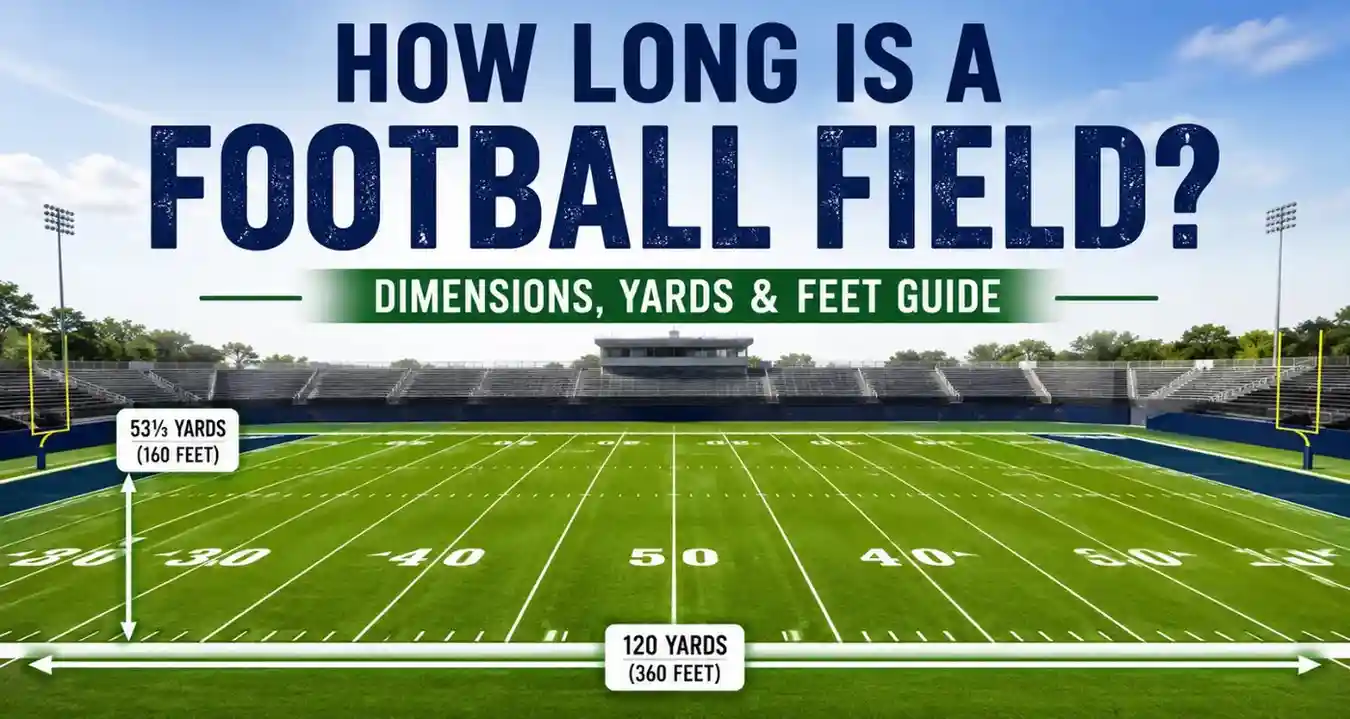
You pace the sidelines, tape measure in hand, unsure if the field matches regulation. Bad measurements lead to unfair games, misinformed bets, and frustrated builders. Stop guessing. This guide hands you every official football field dimension—from blade of grass to end zone stripe—so you master the numbers instantly.
Standard Football Field Length in Feet, Yards, and Meters
A standard American football field stretches 120 yards from the back of one end zone to the back of the other. The playing area between the goal lines sits at exactly 100 yards. Convert that into other units:
- In yards: 100 yards (playing field) + two 10-yard end zones = 120 total yards
- In feet: 300 feet of playing field + two 30-foot end zones = 360 total feet
- In meters: 91.44 meters of playing field + two 9.144-meter end zones = 109.728 total meters
Always measure from the inside edge of the end line to the opposite inside edge. Using the outer boundary gives you a false oversized reading.
How Wide Is a Football Field? Sideline to Sideline
Every standard football field shares the same width, no matter the level of play. The official width is 53 1/3 yards (160 feet). That measurement spans from the inside of one sideline to the inside of the opposite sideline.
This width remains constant from youth leagues to the professional level. The boundary lines themselves are 4 inches wide and painted white. Field width directly affects play-calling—tight formations thrive near the hash marks, while spread offenses exploit the outer thirds.
Football Field Dimensions: NFL vs. College vs. High School
While length and width stay the same, several key differences exist between levels. The table below breaks down the critical variations.
| Feature | NFL | College (NCAA) | High School (NFHS) |
| Total Length | 120 yards | 120 yards | 120 yards |
| Playing Field | 100 yards | 100 yards | 100 yards |
| Width | 53 1/3 yards | 53 1/3 yards | 53 1/3 yards |
| End Zone Depth | 10 yards | 10 yards | 10 yards |
| Hash Mark Width | 18 feet 6 inches apart | 40 feet apart | 53 feet 4 inches apart (divides field into thirds) |
| Goal Post Width | 18 feet 6 inches | 18 feet 6 inches | 23 feet 4 inches |
| Goal Post Crossbar Height | 10 feet | 10 feet | 10 feet |
The hash mark spacing changes how offenses attack. NFL hash marks sit much closer together, shrinking the short side of the field. High school hash marks split the field exactly into thirds, creating balanced horizontal space.
How Many Acres Is a Football Field? (With Visual Comparison)
One football field—including both end zones—covers 1.32 acres. Here’s the simple math:
- Area = Length × Width
- 360 feet × 160 feet = 57,600 square feet
- 1 acre = 43,560 square feet
- 57,600 ÷ 43,560 = 1.32 acres
To visualize that, a football field minus one end zone is roughly the size of a standard city block. Three full football fields nearly equal four acres. Parking lot owners and developers often use the football field comparison to help clients grasp land scale quickly.
The End Zone and Goal Post Placement
Each end zone adds 10 yards to the field’s total length. Goal posts anchor at the back of the end zone in the NFL and NCAA, meaning the uprights sit on the end line. High school rules place the goal post at the front of the end zone on the goal line, making field goal attempts from the 10-yard line roughly 20 yards in total distance.
The crossbar sits 10 feet above the ground across all levels. Kickers visualize the uprights as a vertical extension that rises 30 feet (NFL) or 20 feet (high school) above the crossbar. Wind and weather often turn an easy chip shot into a gamble.
Field Markings: Hash Marks, Yard Lines, and Numbers
White lines, numbers, and hash marks create the visual grid players rely on.
- Yard lines: Every 5 yards, a solid white line runs sideline to sideline. The 50-yard line splits the field exactly.
- Hash marks: Short lines spaced 1 yard apart run down the middle of the field. They determine where the ball is spotted for each play.
- Numbers: Large white numbers appear every 10 yards, starting at the 10-yard line. They face the press box so broadcasters and coaches can read the yardage instantly.
- Sideline boundary: 6-foot-wide white border surrounds the field. Coaches and substitute players must stay inside the coaching box marked here.
These markings operate like a coordinate system. Quarterbacks and receivers use yard lines and numbers to synchronize route depths.
How Many Feet in a Football Field? Quick Conversion Table
Confusing feet with yards costs time. Print or bookmark this quick-reference table.
| Measurement | Feet | Yards | Meters |
| Full field (end zone to end zone) | 360 | 120 | 109.73 |
| Playing field only | 300 | 100 | 91.44 |
| One end zone | 30 | 10 | 9.14 |
| Field width | 160 | 53 1/3 | 48.76 |
| Half the field | 150 (playing) | 50 | 45.72 |
| From goal line to 50-yard line | 150 | 50 | 45.72 |
These numbers help grounds crews paint precise lines and let fans calculate yardage from their seats.
Football Field Background and Surface Choices
Football fields evolved from rugby pitches in the late 1800s. Walter Camp, known as the father of American football, standardized the 110-yard field in 1882, later extended to 120 yards with end zones by 1912. The gridiron nickname came from the early painted vertical lines that resembled a cooking grid.
Surface choices today split between natural grass and artificial turf. NFL stadiums like Lambeau Field use a hybrid grass system reinforced with synthetic fibers. High schools increasingly install turf to reduce maintenance costs. Both surfaces must meet strict hardness and traction standards set by the NFL and NCAA to prevent injury.
How Big Is a Football Field Compared to Other Sports Fields?
Seeing a football field next to other playing areas clarifies its true size.
- Soccer field: FIFA allows lengths from 100 to 130 yards and widths from 50 to 100 yards. A maximum-size soccer field dwarfs a football field, reaching 1.98 acres.
- Baseball field: Outfield dimensions vary wildly, but fair territory often exceeds 2.5 acres. Fenway Park’s left field sits close, while Coors Field sprawls over 2.7 acres.
- Basketball court: An NBA court runs 94 feet by 50 feet, only 0.11 acres. You could fit nearly 12 basketball courts inside one football field.
- Ice hockey rink: NHL rinks are 200 feet by 85 feet. A football field nearly doubles that width.
This spatial context helps event planners and fans understand just how much ground players cover each down.
Why Precision in Field Dimensions Matters for Players and Coaches
Every inch of a football field dictates strategy. A single misaligned hash mark changes the angle for a field goal kick. An end zone 6 inches too short can nullify a touchdown. Coaches design plays that rely on the exact 53 1/3-yard width to stretch defenses.
Groundskeepers use steel tapes and laser measures to certify fields before games. At the professional level, pre-game inspections check goal post alignment, crown height (the slight slope for drainage), and marking accuracy. When precision fails, records and outcomes get challenged. The field isn’t just a stage—it’s a rulebook written in grass and chalk.
Frequently Asked Questions About Football Field Sizes
How many yards is a football field?
A football field measures 120 yards from the back of one end zone to the other. The playing field between the two goal lines is 100 yards long.
How many feet is a football field?
A full football field stretches 360 feet in total. That’s 300 feet of playing field plus two 30-foot-deep end zones.
How many acres is a football field?
One football field covers 1.32 acres. Multiply the 360-foot length by the 160-foot width, then divide by 43,560 square feet per acre.
How many meters is a football field?
The total length of a football field is 109.73 meters. This includes both 9.14-meter end zones and the 91.44-meter playing area.
How wide is a football field?
All regulation football fields share a width of 53 1/3 yards, which equals 160 feet or 48.76 meters. This dimension never varies between NFL, college, or high school.
What is the difference between a football field and a soccer field in size?
A football field is fixed at 120 yards by 53 1/3 yards (1.32 acres). A soccer field varies, ranging from 100 to 130 yards long and 50 to 100 yards wide. Large soccer pitches easily exceed 1.9 acres, making them noticeably wider and longer than football fields.
Your Next Step
You now own the full blueprint of a football field. Use these numbers to plan a construction project, settle a sideline debate, or deepen your coaching toolkit. Share this guide with your crew so everyone speaks the same measurement language. If you found a dimension surprise here, drop a comment below—real-world field stories always teach something new.
Article reviewed by John Fields, former NCAA Division I field manager and sports turf consultant with 15 years of hands-on experience. Sources include the NFL Rulebook (operations.nfl.com), NCAA Football Rules and Interpretations, and the NFHS Football Rules Book.