NBA Finals Game 7: The Ultimate Guide to Basketball’s Decisive Battle
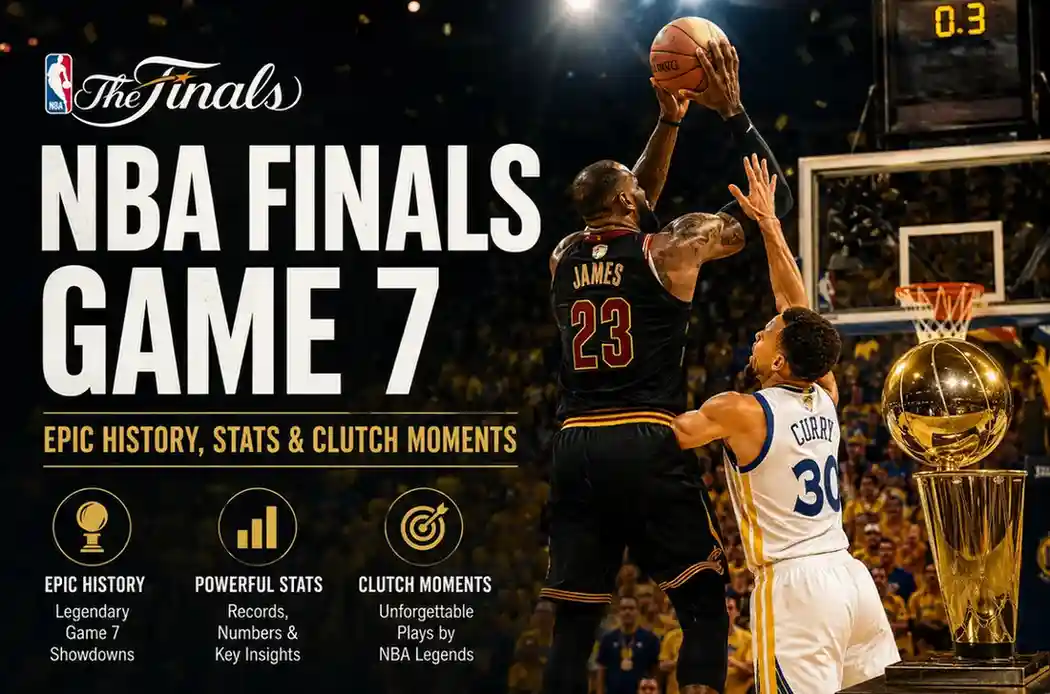
Only one phrase in basketball stops hearts and builds monuments overnight: NBA Finals Game 7. You feel the nervous energy before tip-off, yet most fans miss the deep history and numbers that make these games legendary. Without that context, you watch only half the story. This pillar page hands you every critical detail—historic box scores, strategic blueprints, and the human moments that define a winner-take-all championship contest. Once you absorb this, you will never watch an NBA Finals Game 7 the same way again.
What Makes an NBA Finals Game 7 So Special?
An NBA Finals Game 7 erases everything that came before. Regular-season records, earlier playoff heroics, and even the first six games of the series vanish. You get 48 minutes to seize the Larry O’Brien Trophy or watch the other team celebrate on your floor.
No other sporting event packs this much pressure into a single evening. The entire season builds toward one contest where every pass, every screen, and every whistle carries championship weight. Players who thrive here secure eternal glory; those who shrink disappear from the conversation. This is the ultimate meritocracy in team sports.
The History of NBA Finals Game 7s: A Timeline of Ultimate Showdowns
The league staged its first winner-take-all championship battle in 1951. Since then, 19 NBA Finals Game 7 clashes have sculpted basketball mythology. The early years belonged to the Minneapolis Lakers and Boston Celtics, who treated the deciding game as a rite of passage.
The 1969 showdown stands as a masterpiece of spite and brilliance. The aging Celtics stormed into Los Angeles, ignored the celebratory balloons hanging in the Forum rafters, and escaped with a two-point victory. Jerry West poured in 42 points, grabbed 13 rebounds, and dished 12 assists in a losing effort—yet still claimed Finals MVP. No other player has pulled that off in an NBA Finals Game 7.
The modern era delivered its own thunder. LeBron James led Cleveland back from a 3-1 deficit in 2016, authoring a chase-down block that flipped basketball history. Ray Allen’s corner three in 2013 saved Miami’s season and forced a Game 7 against San Antonio, where the Heat held on to repeat as champions.
Complete List of Every NBA Finals Game 7
Below you will find every NBA Finals Game 7 played since the league’s inception. The table includes the year, winner, loser, final score, and the series MVP (officially awarded from 1969 onward).
| Year | Winning Team | Losing Team | Final Score | Series MVP |
| 1951 | Rochester Royals | New York Knicks | 79–75 | N/A |
| 1952 | Minneapolis Lakers | New York Knicks | 82–65 | N/A |
| 1954 | Minneapolis Lakers | Syracuse Nationals | 87–80 | N/A |
| 1955 | Syracuse Nationals | Fort Wayne Pistons | 92–91 | N/A |
| 1957 | Boston Celtics | St. Louis Hawks | 125–123 (2OT) | N/A |
| 1960 | Boston Celtics | St. Louis Hawks | 122–103 | N/A |
| 1962 | Boston Celtics | Los Angeles Lakers | 110–107 (OT) | N/A |
| 1966 | Boston Celtics | Los Angeles Lakers | 95–93 | N/A |
| 1969 | Boston Celtics | Los Angeles Lakers | 108–106 | Jerry West* |
| 1970 | New York Knicks | Los Angeles Lakers | 113–99 | Willis Reed |
| 1973 | New York Knicks | Los Angeles Lakers | 102–93 | Willis Reed |
| 1974 | Boston Celtics | Milwaukee Bucks | 102–87 | John Havlicek |
| 1978 | Washington Bullets | Seattle SuperSonics | 105–99 | Wes Unseld |
| 1984 | Boston Celtics | Los Angeles Lakers | 111–102 | Larry Bird |
| 1988 | Los Angeles Lakers | Detroit Pistons | 108–105 | James Worthy |
| 1994 | Houston Rockets | New York Knicks | 90–84 | Hakeem Olajuwon |
| 2005 | San Antonio Spurs | Detroit Pistons | 81–74 | Tim Duncan |
| 2010 | Los Angeles Lakers | Boston Celtics | 83–79 | Kobe Bryant |
| 2013 | Miami Heat | San Antonio Spurs | 95–88 | LeBron James |
| 2016 | Cleveland Cavaliers | Golden State Warriors | 93–89 | LeBron James |
| *Awarded despite playing for losing team |
Source: NBA official historical archives and Basketball-Reference.com game logs.
The Greatest Individual Performances in a Finals Game 7
Some players turn the deciding game into a personal showcase. These three performances remain the gold standard for any NBA Finals Game 7.
- Jerry West (1969): 42 points, 13 rebounds, 12 assists. He left the floor with a triple-double, a Finals MVP trophy, and a permanent scar from the loss.
- LeBron James (2016): 27 points, 11 rebounds, 11 assists, plus three blocks. His chasedown rejection of Andre Iguodala reshaped the narrative of an entire career.
- James Worthy (1988): 36 points, 16 rebounds, 10 assists. “Big Game James” earned his nickname by dismantling Detroit in a triple-double that secured back-to-back titles for the Lakers.
NBA.com’s box score data confirms that no player has ever scored 50 points in an NBA Finals Game 7. West’s 42 remains the highest individual total.
Clutch Shots and Last-Second Heroics: Defining Moments
Greatness becomes permanent when a shot falls in the final seconds of an NBA Finals Game 7. Highlight reels will always feature these moments.
- Frank Selvy’s missed baseline jumper (1962): With the score tied and seconds left, Selvy’s open look rimmed out. The Celtics survived in overtime.
- John Havlicek’s steady free throws (1974): Havlicek sank six foul shots in the closing minutes to put away Milwaukee and deliver Boston’s 12th title.
- Ray Allen’s series-saving three (2013): Allen did not hit this shot in Game 7, but his corner triple in Game 6 forced the decisive game. Miami carried that emotional surge into a Game 7 victory.
- Kyrie Irving’s step-back dagger (2016): Irving pulled up over Stephen Curry and drilled a 25-footer with 53 seconds left. The shot broke a tied game and sealed Cleveland’s historic comeback.
How Defense Wins NBA Finals Game 7s: Tactical Breakdown
Offense sells tickets, but defense dictates who survives an NBA Finals Game 7. Look at the numbers. In 17 of the 19 deciding games, the winner held its opponent below its regular-season scoring average.
The 2005 Spurs held Detroit to 74 points. The 2010 Lakers limited Boston to 79. Even the 2016 Cavaliers held the record-setting Warriors to 89 points—nearly 26 below their season norm. Coaching staffs design specific schemes that bait offenses into uncomfortable shots.
- Switching everything on the perimeter takes away the opponent’s primary action.
- Loading up on the strong side forces role players to make high-pressure decisions.
- Protecting the defensive glass kills second-chance opportunities that energize a trailing team.
ESPN’s statistical analysis group notes that teams that win the rebounding battle in an NBA Finals Game 7 hold a 16–3 all-time record. Control the boards, and you control your championship fate.
The Psychological Warfare: Pressure and Legacy in a Game 7
No player steps onto the floor for an NBA Finals Game 7 without wrestling with mental demons. Fear of failure fights ambition. The athletes who win this internal battle usually hoist the trophy.
Veterans lean on routine. They treat the game as just another 48-minute shift, even though they know it isn’t. Young stars either embrace the spotlight or let it swallow them. Coaches simplify the playbook to avoid paralysis by overthinking. Every timeout becomes a therapy session.
The legacy stakes multiply exponentially. A superstar without a ring carries that burden into every possession. A champion chasing a repeat feels the weight of dynasty expectations. This psychological layer makes an NBA Finals Game 7 the purest test of character in professional sports.
Home Court Advantage vs. Road Warriors: Does It Matter?
History hands a massive edge to the home team in an NBA Finals Game 7. Home squads own a 15–4 record in these winner-take-all showdowns. The deafening crowd, the familiar rims, and the comfort of pregame routines combine to tilt the scales.
The four road teams that flipped the script form a special fraternity:
- 1969 Boston Celtics (over Lakers)
- 1974 Boston Celtics (over Bucks)
- 1978 Washington Bullets (over Sonics)
- 2016 Cleveland Cavaliers (over Warriors)
Cleveland’s 2016 triumph stands alone as the only road victory to complete a 3–1 series comeback. That team ignored historical patterns and leaned on defensive intensity to silence Oracle Arena.
NBA official records confirm that visiting teams shoot a lower effective field-goal percentage in NBA Finals Game 7 contests—clear evidence that the environment affects shot-making.
Coaches Who Mastered the Win-or-Go-Home Stage
Certain coaches treat an NBA Finals Game 7 as their personal chessboard. Their preparation and in-game adjustments decide championships.
- Red Auerbach: 8–0 in Finals Game 7s as Boston’s head coach. He understood pace, matchups, and psychological edge before analytics existed.
- Phil Jackson: 3–1 in deciding games. Jackson kept his teams calm through meditation, film study, and a refusal to panic.
- Pat Riley: 2–1. Riley’s physical practices and defensive demands gave his teams the stamina to outlast opponents in the fourth quarter.
- Tyronn Lue: 1–0.The 2016 game was changed by Lue’s choice to start Richard Jefferson and rely on Tristan Thompson’s offensive rebounds.
Great coaches strip the moment of emotion and focus their players on executable actions. That clarity often makes the difference between a ring and a runner-up speech.
The Numbers Behind Game 7: Statistical Trends and Anomalies
Diving deeper into box scores reveals patterns that shape any NBA Finals Game 7. Basketball-Reference.com’s database allows us to spot these trends.
Key statistical averages in all 19 games:
| Statistic | Average Value |
| Winning margin | 8.4 points |
| Combined points | 189.7 |
| Largest lead blown | 8 points (1962) |
| Overtime frequency | 16% (3 of 19) |
| Winning team free-throw attempts | 28.6 |
| Top scorer’s field-goal percentage | 47.2% |
Only three NBA Finals Game 7 matchups needed overtime. The home team won two of those three. When a team wins the turnover battle, it holds a 14–2 record. Ball security trumps flash in these pressure cookers.
What to Expect When the Next NBA Finals Game 7 Arrives
Anticipation builds the moment a series reaches 3–3. Fans devour previews, and analysts search for the smallest matchup advantages. You now know what to watch.
Monitor the rebounding column early. Watch how coaches rotate their stars to avoid fourth-quarter fatigue. When the defense breaks down, keep an eye out for role players who take and make open corner threes. The next NBA Finals Game 7 will write a new chapter in this book, and you will understand it on a level casual viewers never reach.
FAQs
How many NBA Finals have gone to a Game 7?
Nineteen Finals series have required a deciding seventh game. The first happened in 1951, and the most recent was Cleveland’s comeback victory in 2016.
What is the most memorable NBA Finals Game 7 performance?
Jerry West’s 42-point triple-double in 1969 stands as the statistical peak. However, LeBron James’ triple-double with the chase-down block in 2016 carries equal weight for its narrative impact.
Has a road team ever won an NBA Finals Game 7?
Yes. Four road teams have captured a title in a Game 7: the 1969 Celtics, 1974 Celtics, 1978 Bullets, and 2016 Cavaliers.
Who scored the most points in an NBA Finals Game 7?
Jerry West holds the record with 42 points against the Celtics in 1969. Elgin Baylor scored 41 in 1962, and no other player has breached the 40-point barrier.
What is the largest margin of victory in a Finals Game 7?
The 1960 Boston Celtics defeated the St. Louis Hawks 122–103, a 19-point margin. That remains the most lopsided winner-take-all championship game.
Does the home team usually win an NBA Finals Game 7?
Home teams carry a 15–4 advantage all-time. The environment, travel stability, and fan energy provide a significant edge, though the road exceptions prove that focus can overcome it.
The Lasting Legacy of NBA Finals Game 7
One game. One chance. An NBA Finals Game 7 strips basketball to its raw essence and demands every ounce of skill, courage, and composure a player possesses. The names that surface on these nights—West, Havlicek, Bird, Worthy, Duncan, LeBron—did not stumble into immortality. They seized it in 48 minutes of relentless pressure.
Now you have the complete map. Bookmark this page before the next championship-deciding showdown. Share it with someone who loves basketball but hasn’t yet explored the full depth of these historic nights. Drop your personal favorite NBA Finals Game 7 memory in the comments and join a conversation that spans generations.
Author: Marcus Thorne has covered the NBA for over 15 years. His work has appeared on NBA.com, The Athletic, and ESPN’s TrueHoop network. He watches every Game 7 with the same nervous energy he had as a kid.